Smart home automation has become essential for short-term rental hosts and property managers. From lock codes and thermostats to lighting and safety devices, automation is what enables remote management at scale.
But here’s the uncomfortable truth most platforms don’t talk about:
Smart home devices fail constantly — just not always in obvious ways.
Wi-Fi drops. Devices go to sleep. Batteries die. Clouds hiccup. Hubs reboot. Power flickers. And all of it tends to happen at the worst possible time — right before check-in.
That’s why a robust retry and recovery system isn’t a “nice to have.”
It’s foundational infrastructure.
The Real Problem with Smart Home Automation
Most automation platforms assume a best-case scenario:
- Devices are online
- Networks are stable
- Commands execute instantly
- Failures are rare and obvious
That assumption works fine for a single home you live in.
It does not work for short-term rentals.
STR operators deal with:
- Devices spread across multiple properties
- Guests constantly entering and exiting
- Hardware that must work on a schedule — not “eventually”
- Limited ability to troubleshoot in person
In this environment, a single failed command can cascade into:
- Guests locked out
- Incorrect temperatures
- Manual intervention at the worst possible time
- Emergency calls that could have been avoided
Why “Fire Once and Hope” Doesn’t Work
Many platforms treat device commands as one-and-done:
- Send command
- If it fails, surface an error
- Put the burden on the user
That approach creates unnecessary stress for hosts because:
- Many failures are temporary
- The platform gives up too early
- Users are alerted before a problem is actually real
- Hosts are forced to babysit automations
In short-term rentals, temporary failure is normal — and systems must be designed to expect it.
Reliability Comes from Persistence, Not Perfection
A robust retry system acknowledges reality:
Devices won’t always respond immediately — but they often will if given time.
The key is having a system that:
- Automatically retries failed actions
- Adapts over time instead of hammering devices
- Resolves transient issues quietly in the background
- Escalates only when human intervention is truly needed
This is where most generic smart home platforms fall short.
Retry mechanisms and backoff strategies are a widely accepted best practice in cloud and distributed systems, where temporary failures are expected and handled automatically.
Built for Short-Term Rentals, Not Single Homes
Our retry and recovery logic was designed specifically for short-term rental operators and hosts — not homeowners tweaking automations manually.
That means we optimize for:
- Calendar-driven actions (check-in, check-out, turnovers)
- Remote reliability, even when nobody is on-site
- Minimal alerts, so you’re not notified about problems that resolve themselves
- Eventual correctness, so devices always converge to the desired state
Instead of asking “Did this command succeed instantly?”
We ask:
“Did the device end up where it needed to be?”
That difference matters.
Fewer Alerts, Less Stress, Happier Guests
One of the biggest benefits of a robust retry system is what doesn’t happen:
- No false-alarm notifications
- No unnecessary manual intervention
- No late-night panic over temporary outages
- No micromanaging device status
Most transient issues resolve automatically before guests ever notice — which is exactly how it should be.
And when a problem does persist?
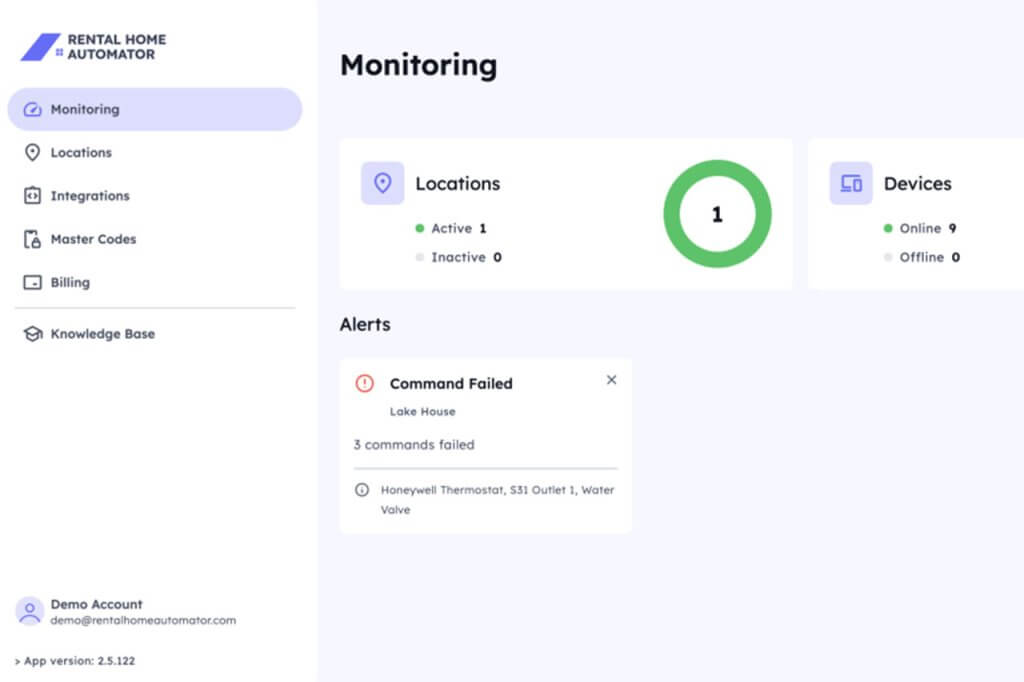
You’re alerted with confidence that:
- The system has already tried everything reasonable
- The issue is unlikely to self-resolve
- Your attention is actually required
Designed for Scale, Not Babysitting
Short-term rental operators don’t want to:
- Re-send commands manually
- Watch logs
- Wonder if automations “really ran”
- Hope devices recover on their own
A proper retry system turns automation into infrastructure — something you trust and forget about.
Whether you manage:
- One unit
- A handful of properties
- Or dozens across multiple locations
The system behaves the same way:
Quietly persistent. Intentionally conservative. Relentlessly reliable.
Automation You Can Actually Rely On
Smart home automation should reduce workload — not add a new category of problems to monitor.
A robust retry and recovery system ensures that:
- Temporary failures stay temporary
- Devices reach their intended state
- Guests have seamless experiences
- Hosts can focus on operations, not troubleshooting
It’s not flashy.
It’s not visible.
But it’s one of the most important parts of making smart home automation actually work in the real world of short-term rentals.
Our platform is built to handle real-world device behavior automatically—so your locks, thermostats, and other devices stay in sync without constant monitoring.