Disclosure: This page contains affiliate links. If you purchase through these links, Rental Home Automator may earn a commission at no additional cost to you. As an Amazon Associate I earn from qualifying purchases.
Zooz ZEN71 Z-Wave On/Off Switch
The Zooz ZEN71 is one of our favorite smart switches for short-term rental properties. After years of using these switches throughout our properties, we’ve been consistently impressed by their reliability, excellent build quality, and practical design.
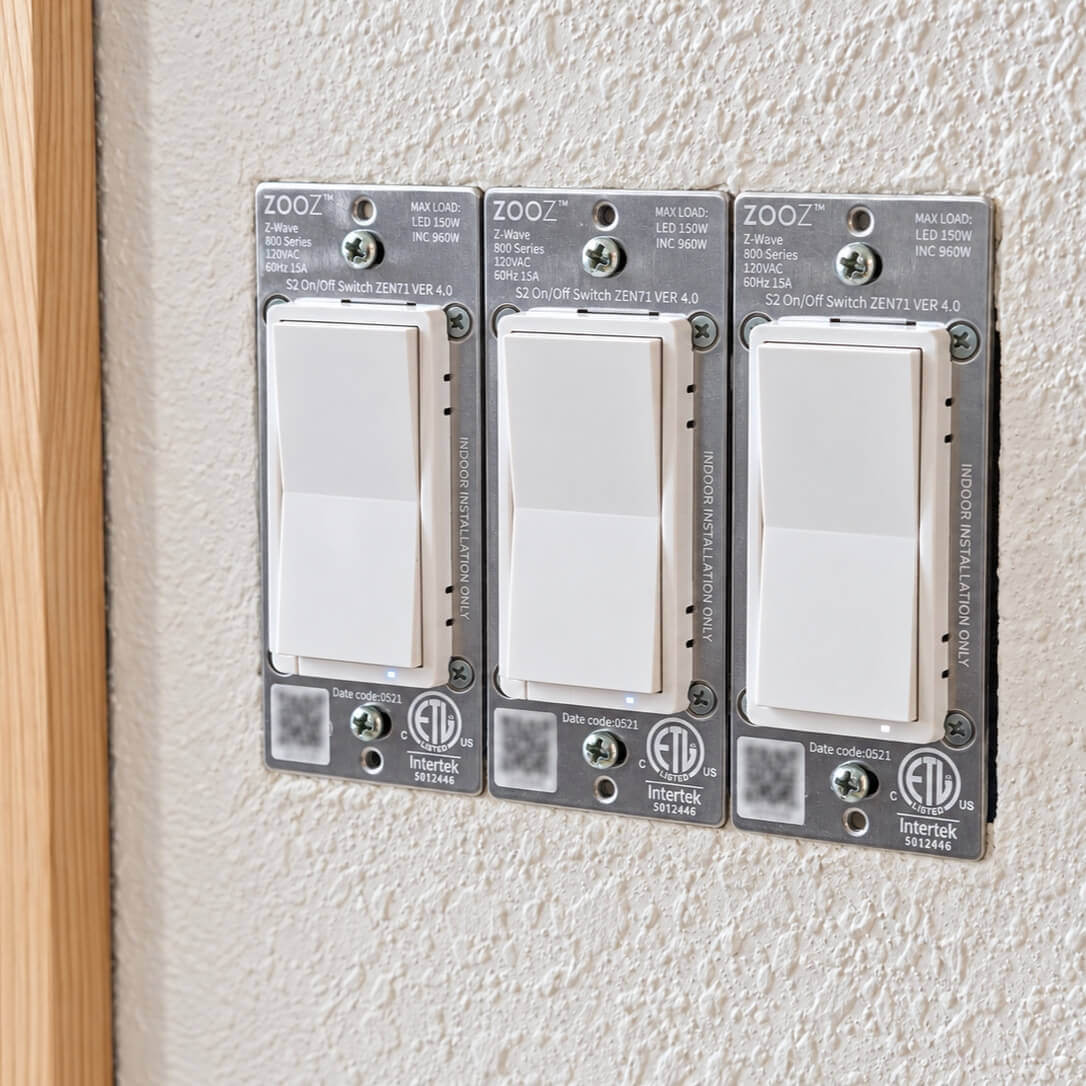
Unlike some smart switches that are bulky or difficult to install, the ZEN71 has a relatively compact body, uses screw terminals rather than preattached wire leads, and fits comfortably alongside other switches in multi-gang electrical boxes.
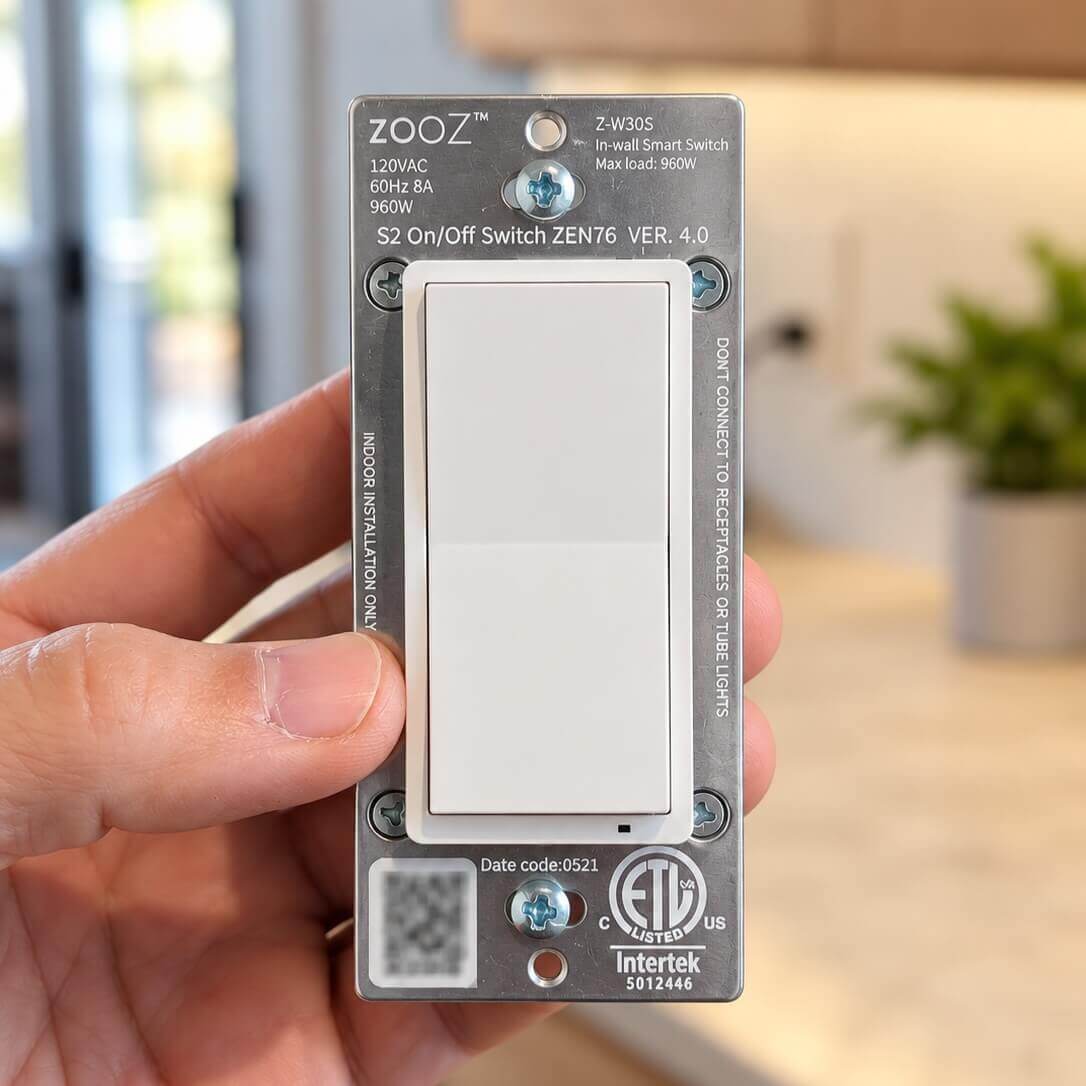
We also love the conventional paddle design. The switches have a satisfying tactile feel and operate exactly as guests expect, without requiring instructions or familiarity with smart-home technology.
Another standout feature is support for both single-pole and compatible 3-way installations, with no need to purchase a special companion switch.
Our verdict: Highly Recommended. For properties with Z-Wave infrastructure, the ZEN71 is one of the best smart on/off switches we’ve tested and remains a top choice for rental lighting automation.
Compact Design Makes Installation Easier
One of the things we appreciate most about the ZEN71 is its physical design.
Many smart switches are significantly larger than traditional mechanical switches, which can make installation challenging, especially in older electrical boxes or multi-gang configurations.
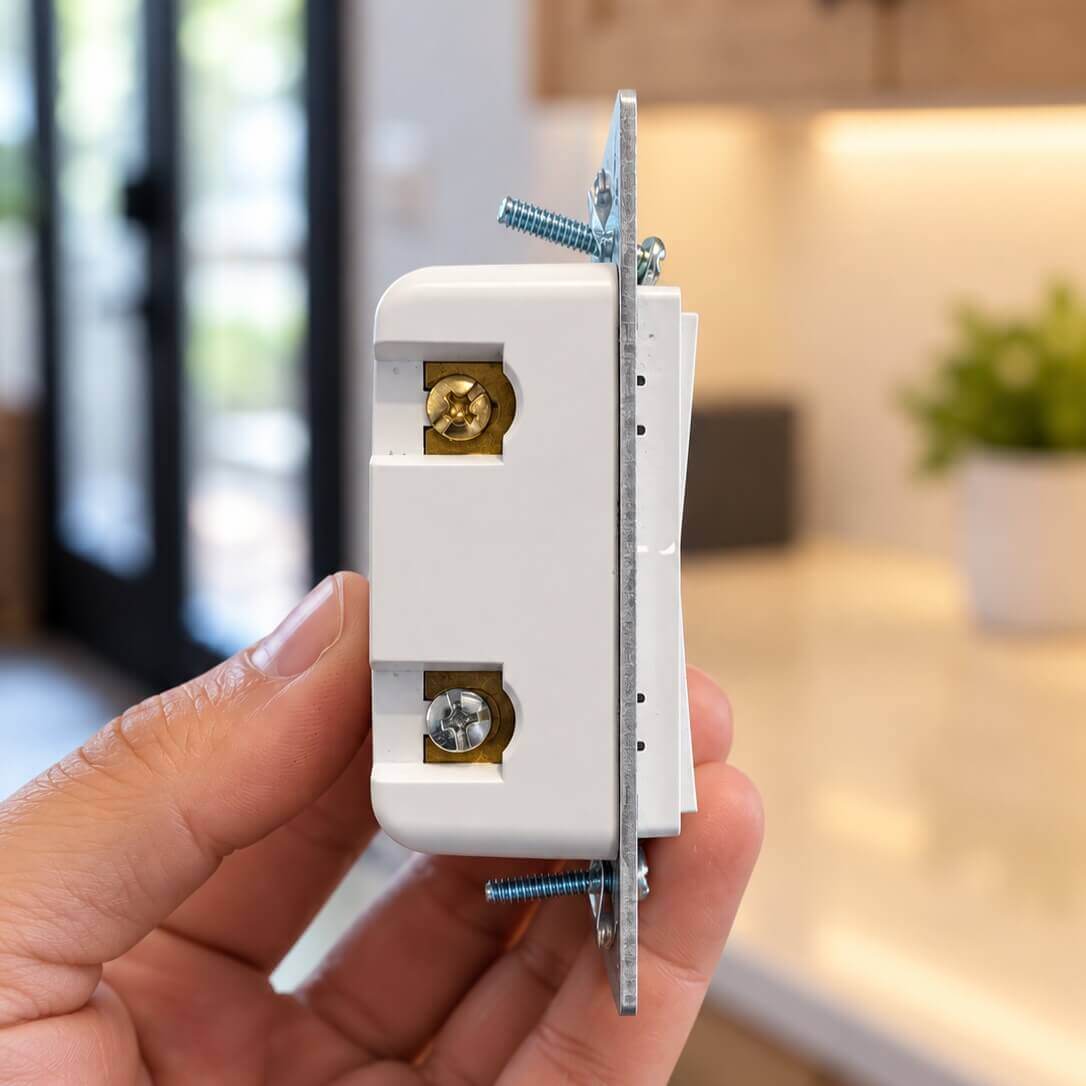
The ZEN71 is relatively shallow at approximately 1.16 inches deep and doesn’t have bulky heat-sink tabs or preattached wiring pigtails.
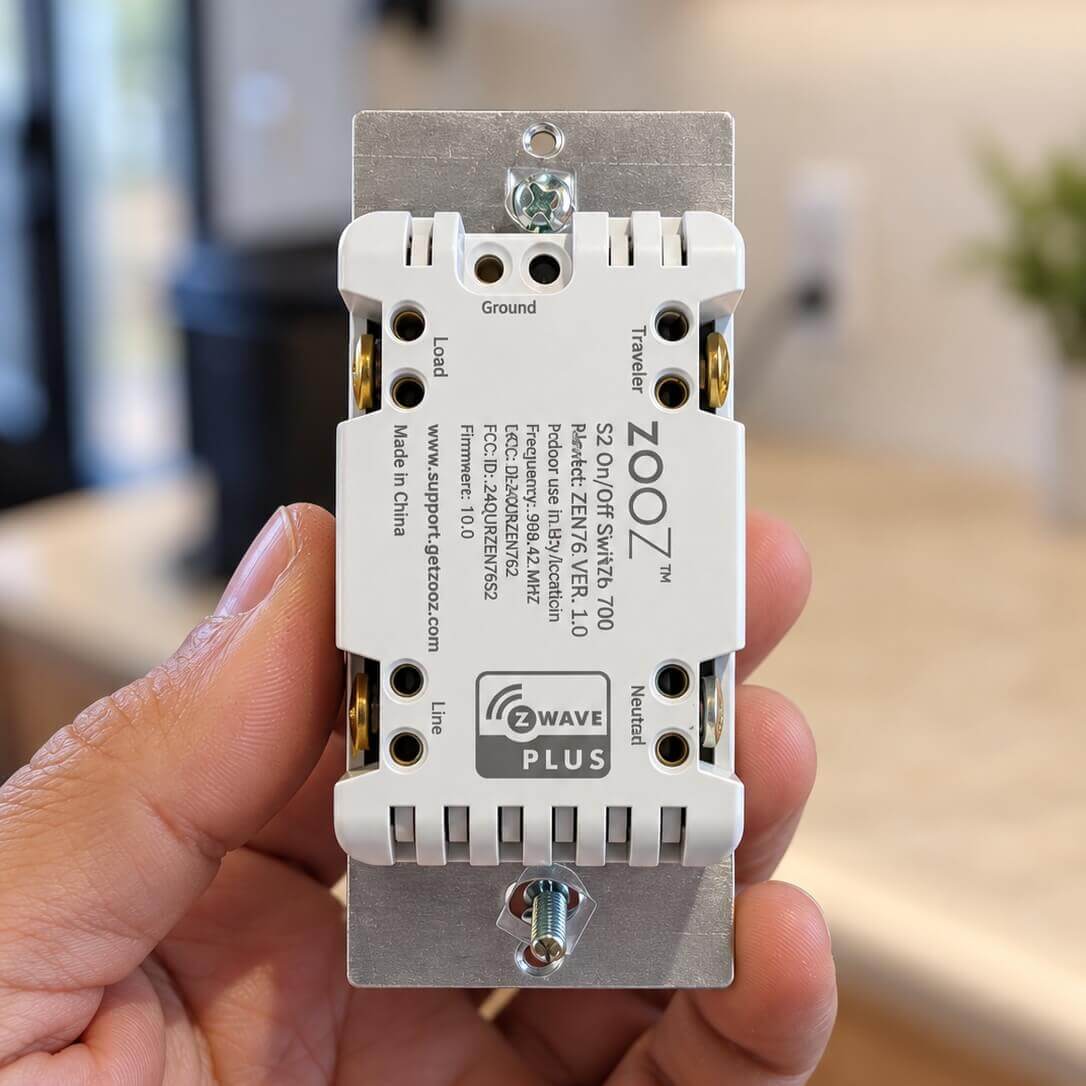
Instead, the wires connect directly to terminals on the switch.
We prefer this arrangement because it reduces unnecessary wiring inside the electrical box and makes installation much cleaner.
We’ve installed multiple Zooz switches side by side, and their compact construction makes them noticeably easier to work with than some competing smart switches.
Of course, electrical-box capacity and wiring still matter. The ZEN71 requires a neutral wire, and the installation must meet the manufacturer’s instructions and applicable electrical codes.
But from a physical installation standpoint, this is one of the more thoughtfully designed smart switches we’ve used.
Single-Pole and 3-Way Support Without a Special Companion Switch
Another major advantage is the ZEN71’s flexibility.
The switch supports standard single-pole installations and compatible 3-way circuits, allowing lights to be controlled from two locations.
What makes this particularly attractive is that you don’t need to purchase a second smart switch or proprietary companion device.
In many configurations, the ZEN71 can work alongside an ordinary mechanical 3-way on/off switch.
This can reduce the cost of upgrading existing lighting circuits, especially in hallways, stairways, and rooms with multiple entrances.
We’ve found this flexibility particularly valuable when installing smart switches throughout our properties.
There is an important installation consideration, however. Z-Wave switches don’t necessarily use the same wiring arrangement as the switches they replace. A 3-way conversion may require changes in both electrical boxes, and the appropriate configuration depends on where the line, load, neutral, and traveler wires are located.
The companion switch must also be a compatible mechanical on/off switch—not an ordinary dimmer or incompatible electronic add-on.
Zooz provides detailed ZEN71 single-pole and 3-way wiring guidance, which we recommend reviewing before installation.
For anyone uncomfortable identifying electrical wiring, we’d recommend having a qualified electrician complete the work.
Excellent Tactile Feel and Guest-Friendly Controls
A smart switch can have excellent automation capabilities and still be a poor choice for a rental property if guests find it confusing.
That’s one reason we like the ZEN71 so much.
The paddle feels solid and responsive, and the controls are familiar to anyone who has used a modern wall switch.
Press the top to turn the connected light on and the bottom to turn it off.
There’s no touch-sensitive surface to figure out, no unusual button arrangement, and no need to explain how the switch operates.
The ZEN71 also maintains conventional physical lighting control even when guests aren’t interacting with the smart-home system.
We’ve used these switches extensively throughout our properties, and they have held up very well.
For us, this combination of durability, tactile quality, and intuitive operation is exactly what we want from a guest-facing smart switch.
One distinction worth noting: the ZEN71 is an on/off switch, not a dimmer. For adjustable lighting levels, we’d choose one of Zooz’s dedicated dimmer models instead.
Convenient QR Code Placement
This is a relatively small detail, but one of our favorite features is the placement of the Z-Wave QR code.
Zooz prints the security QR code on the switch’s metal mounting plate, accessible from the front once the decorative wall plate is removed.
This makes it much easier to access the device information when pairing or troubleshooting the switch.
With some competing devices, pairing information is printed on the back or side of the housing, meaning you may have to remove the entire switch from the electrical box to find it.
When managing multiple smart switches across several properties, easy access to that information is a genuine advantage.
It’s another example of Zooz thinking about how these devices will actually be installed and maintained over time.
Z-Wave Connectivity and Long-Term Reliability
The ZEN71 uses Z-Wave rather than Wi-Fi, connecting directly to a compatible Z-Wave hub.
We generally prefer this approach for short-term rentals because it keeps individual switches off the property’s Wi-Fi network and avoids requiring a separate manufacturer cloud account for basic device communication.
The ZEN71 also acts as a repeater when operating as part of a conventional Z-Wave mesh, helping extend coverage for other compatible Z-Wave equipment.
Our long-term experience has been excellent.
We’ve installed Zooz switches throughout our properties and have relied on them for years with very few problems.
We have occasionally discovered a switch that was no longer communicating with the Z-Wave network. However, we couldn’t determine exactly when it disconnected or whether the problem was caused by the switch, SmartThings, or another part of the network.
These incidents have been infrequent and haven’t meaningfully affected our confidence in the hardware.
Overall, the ZEN71 has been one of the most dependable smart switches we’ve used.
SmartThings Integration and Edge Drivers
We’ve primarily used the ZEN71 with Samsung SmartThings, where it provides straightforward remote on/off control and integration with compatible automation routines.
However, there’s one important detail for SmartThings users.
To access all of the ZEN71’s advanced configuration options, we recommend installing Zooz’s custom SmartThings Edge driver.
The process is relatively simple, but it’s an additional step that may not be obvious to someone installing their first Zooz switch.
Depending on the device version and firmware, its advanced options can include configuring the LED indicator, setting power-restoration behavior, enabling scene controls, and adjusting how the switch responds to physical commands.
We particularly appreciate the ability to configure whether the switch returns to its previous state following a power outage.
Zooz also supports additional capabilities such as multi-tap scene control and smart-bulb mode, although the exact functionality available depends on the integration and driver.
Once configured, these options make the ZEN71 considerably more flexible than an ordinary on/off switch.
Zooz provides official instructions for installing the ZEN71 SmartThings Edge driver.
The only other infrastructure requirement is a SmartThings hub with actual Z-Wave support. Not all newer SmartThings-compatible hubs include a Z-Wave radio.
Why We Like the ZEN71 for Short-Term Rentals
Smart switches are one of our favorite ways to automate lighting at rental properties because they preserve normal wall-switch operation while adding remote control.
Unlike smart bulbs, which can stop responding when a guest turns off their power at a traditional wall switch, an appropriately installed ZEN71 controls the circuit directly.
That makes it well suited to entry lighting, hallways, exterior lighting circuits, and other suitable hardwired lighting loads.
For example, compatible lighting can be turned on before a guest arrives and returned to a preferred state after checkout.
Through Rental Home Automator, supported switches can be included in reservation-aware lighting automations based on guest check-in, checkout, and vacancy periods.
Guests still have ordinary physical controls during their stay, which is important. We don’t want automation making simple tasks unnecessarily complicated.
For more information, read our guide to lighting automation for short-term rentals.
What We Don’t Like
There isn’t much we dislike about the ZEN71, but a few considerations are worth mentioning.
Z-Wave requires a compatible hub. If your smart-home system is built entirely around Zigbee or Matter over Thread, you’ll need to maintain Z-Wave infrastructure to use this switch.
Pairing and exclusion can occasionally be finicky. This is more of a general Z-Wave consideration than a specific criticism of the ZEN71, but it can make installation or network changes less convenient.
SmartThings needs the appropriate Edge driver for full configuration. Basic operation is straightforward, but access to the more advanced Zooz features requires an additional setup step.
It’s not a dimmer. If you want gradual brightness control, choose a dedicated Zooz dimmer rather than the ZEN71.
Finally, although our switches have been highly reliable over the years, we’ve encountered a small number of unexplained Z-Wave disconnections. We can’t confidently attribute these to the Zooz hardware itself.
None of these drawbacks would prevent us from purchasing the ZEN71 again.
Final Verdict
The Zooz ZEN71 is one of the best smart on/off switches we’ve tested for short-term rentals.
We love its relatively compact size, clean terminal-based wiring, excellent tactile feel, and ability to fit alongside other smart switches in multi-gang electrical boxes.
Support for compatible mechanical 3-way switches is another major advantage, eliminating the need for a specialized companion switch.
The easily accessible QR code is a thoughtful detail, and its advanced Z-Wave features provide extensive configuration options for those who want them.
Most importantly, we’ve used these switches throughout our properties for years, and they’ve proven to be exceptionally dependable.
Our biggest reservation is the continued requirement for a Z-Wave hub rather than newer Matter-over-Thread infrastructure. But given how well Z-Wave has worked for us, we don’t consider that a reason to avoid an otherwise excellent switch.
We highly recommend the Zooz ZEN71 for anyone building or maintaining a Z-Wave-based smart-home system, particularly at short-term rental properties.
For our other smart-home recommendations, see Best Smart Home Devices for Airbnb and our Zooz ZEN30 Double Switch review.
Zooz On/Off Switch ZEN71 Review
The Zooz ZEN71 is one of our favorite Z-Wave smart switches for short-term rentals. After years of extensive use, we've been impressed by its reliability, excellent tactile feel, compact construction, and straightforward installation. Direct wire terminals, an accessible QR code, and support for standard mechanical 3-way switches make it particularly appealing. SmartThings users should install the Zooz Edge driver for full configurability, but overall, this is an outstanding smart switch that we highly recommend.
10/10
Total Score
-
Suitability for STRs10/10Intuitive physical controls, durable construction, and permanent installation
-
Cost9/10Good value, especially with ordinary 3-way companion switches
-
Privacy/Security10/10Z-Wave connectivity without a separate manufacturer cloud account
-
Usability10/10Excellent tactile feel, compact design, and straightforward controls
-
Reliability9/10Excellent long-term performance with rare, unexplained network disconnections
The Good
- Excellent long-term reliability
- Compact, shallow housing
- No preattached wire pigtails
- Standard mechanical 3-way support
- Great tactile feel for guests
The Bad
- Requires a Z-Wave hub
- Requires neutral wiring
- Occasional Z-Wave network issues
- No brightness control (on/off only)
About our reviews: We test and evaluate smart-home devices specifically for short-term rental use. Our goal is to help hosts choose equipment that is reliable, secure, and compatible with rental automation. Rental Home Automator is our software platform, so our recommendations also consider how devices fit into an automated rental setup.
Other Device Reviews