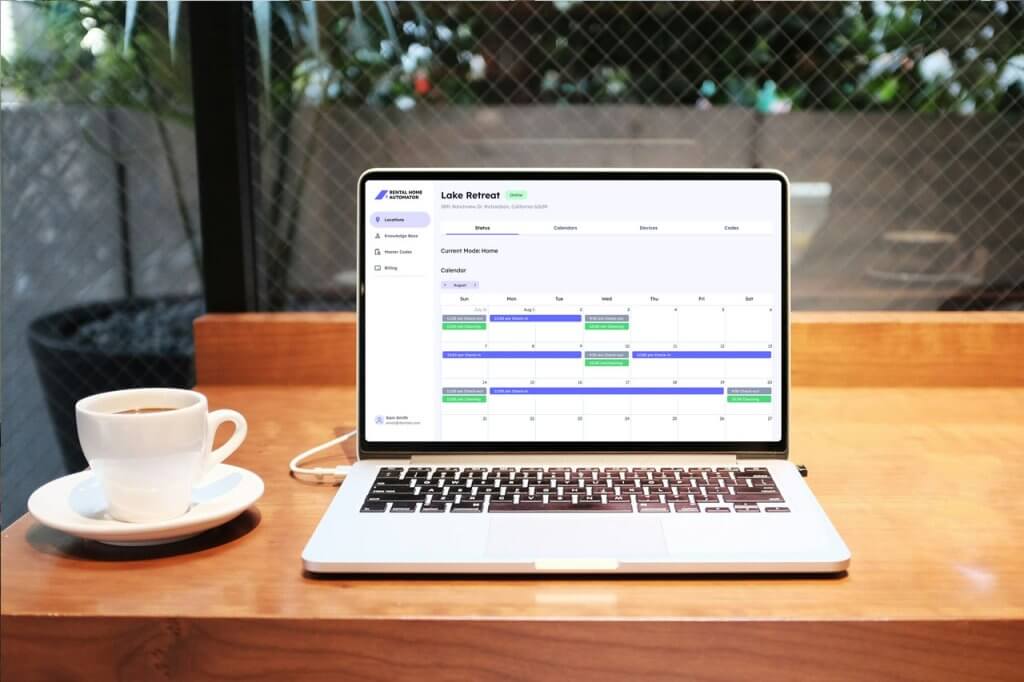

Calendar-based automation is one of the most powerful ways to reduce manual work at an Airbnb or vacation rental. Instead of manually managing locks, thermostats, lights, and other devices between reservations, calendar-based automation allows your booking calendar to automatically control how your property operates.
Most hosts don’t have a smart home problem.
They have an operations problem.
Guests check in late. Cleaners arrive early. Thermostats get left running. Lights stay on. Water leaks go unnoticed. Access codes need to be updated. Every reservation creates another list of repetitive tasks that must be completed before the next guest arrives.
Many hosts try to solve these challenges by installing smart locks, thermostats, cameras, and sensors. While those devices help, they only solve part of the problem.
The real breakthrough happens when your property begins responding automatically to reservations.
That is the idea behind calendar-based automation.
Instead of managing individual devices, calendar-based automation connects your booking calendar directly to the systems inside your property. Every check-in, checkout, cancellation, owner stay, maintenance visit, and vacancy period becomes an opportunity to automate operations.
The result is a smarter property that requires less manual intervention, delivers a better guest experience, and scales far more easily as your portfolio grows.
If you’re new to automation, start with our complete guide to short-term rental automation.
What Is Calendar-Based Automation?
Calendar-based automation is the process of using reservation events to automatically control smart devices and operational workflows at your property.
Rather than relying on schedules, motion sensors, or manual actions, the automation system responds directly to booking activity.
For example:
- A guest checks in at 4:00 PM
- The thermostat switches to guest comfort mode
- Guest lock codes become active
- Exterior lighting schedules adjust
- Vacancy protections are disabled
Then, when the reservation ends:
- Guest access codes expire
- Thermostats return to energy-saving settings
- Water protection automations activate
- Certain devices power down automatically
The booking calendar becomes the trigger that controls the property.
This concept is often referred to as rental-aware automation because the system understands whether the property is occupied, vacant, being cleaned, or undergoing maintenance.
Why Traditional Smart Homes Struggle With Short-Term Rentals
Most smart home platforms were designed for homeowners.
A homeowner’s daily routine is relatively predictable.
They leave for work.
Then they come home.
Later they go to bed.
Smart home automations are designed around those behaviors.
Short-term rentals operate differently.
Every week brings different guests.
Check-in times vary.
Reservations are modified.
Bookings get canceled.
Cleaners need temporary access.
Maintenance visits occur unexpectedly.
Traditional smart home automations have no concept of reservations.
They know:
- Time of day
- Motion activity
- Device states
But they do not know:
- A guest is arriving tomorrow
- A reservation was canceled
- The property will be vacant for five days
- A cleaner needs access between stays
This creates a significant gap between basic smart home automation and true rental automation.
The Calendar Is the System
One of the biggest lessons we’ve learned after years of automating short-term rentals is this:
The calendar is the system.
Every important operational decision ultimately depends on occupancy.
When a property becomes vacant:
- Access permissions change
- Thermostat settings change
- Water protection requirements change
- Alert priorities change
- Energy management priorities change
When guests arrive:
- Access needs change
- Comfort settings change
- Monitoring expectations change
Most hosts initially focus on devices.
Experienced operators eventually realize that reservations drive everything.
Devices simply execute the operational decisions.
That’s why calendar-based automation is fundamentally different from traditional smart home automation.
Instead of automating devices, you’re automating operations.
For a broader overview of automation opportunities, see What Can I Automate at My Short-Term Rental Property.
Why Calendar-Based Automation Is So Rare
If calendar-based automation is so powerful, why don’t more platforms offer it?
The answer is simple:
Because it’s difficult.
Most smart home platforms were built for homeowners, not short-term rentals.
Turning a light on when motion is detected is relatively easy.
Turning a thermostat down at midnight is relatively easy.
But reservations are constantly changing.
Guests extend stays.
Reservations are canceled.
Check-in dates move.
Cleaners need temporary access.
Maintenance visits need different rules than guest stays.
The automation system must continuously interpret calendar events and translate them into actions throughout the property.
That level of coordination is significantly more complicated than traditional smart home automation.
As a result, most platforms avoid the problem entirely.
Some platforms offer limited calendar integrations, but they typically focus on only one or two device categories such as locks or thermostats.
Others require expensive enterprise software that is often difficult for independent hosts to justify.
When we built Rental Home Automator, we started with a different philosophy:
The reservation should be the trigger.
Everything else should follow.
Instead of asking hosts to automate individual devices, we built a system that allows booking events to automate operations across locks, thermostats, lights, switches, outlets, water valves, leak sensors, and more.
Because at a short-term rental, reservations drive everything.
Why Calendar-Based Automation Becomes More Valuable Over Time
A host managing one property can often handle tasks manually.
The challenge appears when growth begins.
Each additional property increases:
- Lock code management
- Thermostat management
- Turnover coordination
- Monitoring requirements
- Maintenance tracking
- Energy management
With five properties, dozens of operational tasks may occur every day.
With ten properties, manual management becomes increasingly difficult.
Calendar-based automation removes repetitive work from the equation.
Instead of creating lock codes manually, they’re generated automatically.
In place of remembering to adjust thermostats, the system handles it.
Rather than of worrying about vacancy periods, automations enforce your policies consistently.
The larger your portfolio becomes, the more valuable automation becomes.
Hosts managing a property from out of town – or even out of state – should also read How To Manage Your Airbnb Remotely.
What Can You Automate Using Your Booking Calendar?
One of the biggest misconceptions about rental automation is that it only applies to smart locks.
In reality, nearly every operational system inside a property can benefit from calendar awareness.
Smart Lock Automation
Guest access management is often the first automation hosts implement.
Calendar-based automation can:
- Create guest codes automatically
- Activate codes before check-in
- Expire codes after checkout
- Manage cleaner access
- Support maintenance personnel
This eliminates many manual tasks while improving security.
Learn more: Rental Lock Automation: The Smart Way to Secure Your Short-Term Rental
If you’re selecting hardware, we strongly recommend Z-Wave smart locks over Wi-Fi alternatives because of their reliability, battery life, and resistance to guest network issues.
Recommended reading:
Thermostat Automation
HVAC costs are often one of the largest operating expenses at a short-term rental.
Calendar-based automation allows hosts to automatically:
- Pre-condition properties before arrival
- Enter energy-saving modes after checkout
- Manage shoulder seasons more effectively
- Reduce unnecessary heating and cooling
Instead of relying on guests to adjust temperatures responsibly, the property can automatically adapt based on occupancy.
Learn more: Thermostat Automation: A Smart Move for Short-Term Rentals
Recommended thermostat: ecobee Smart Thermostat Essential
Lighting Automation
Lighting automation can improve both guest experience and operational efficiency.
Examples include:
- Arrival lighting scenes
- Vacancy lighting shutdowns
- Cleaner work lighting
- Security lighting schedules
When integrated with calendar events, lighting becomes much more intelligent than simple time-based schedules.
Learn more: Lighting Automation for Short-Term Rentals: A Smart Way to Improve Guest Experience
Water Protection Automation
Water damage remains one of the most expensive risks facing short-term rental operators.
A small leak discovered quickly may cost hundreds of dollars.
The same leak discovered days later can cost tens of thousands.
Calendar-aware automation allows hosts to take a more proactive approach.
For example:
- Activate vacancy protection after checkout
- Shut off water during extended vacancy periods
- Adjust monitoring priorities based on occupancy
- Coordinate leak sensors with custom alerts
This is one of the most valuable automations available for remote hosts.
Learn more:
- Water Shut-Off Valve Automation for Airbnb: The Smart Way to Protect Your Rental
- Leak Sensors for Short-Term Rentals: Why Water Monitoring Is Non-Negotiable
Recommended device: Zooz Titan Water Valve 700 Series
Cleaning & Turnover Automation
Turnovers create dozens of operational tasks.
Calendar-based automation can help coordinate:
- Cleaner access
- Thermostat settings
- Lighting behavior
- Property readiness checks
- Maintenance windows
Instead of manually preparing the property for every reservation, many of these tasks can happen automatically.
Learn more: Airbnb Cleaning Automation: How to Simplify Turnovers at Your Short-Term Rental
Why We Generally Avoid Wi-Fi Devices for Critical Rental Systems
Many hosts begin their automation journey with Wi-Fi smart devices.
At first glance, they seem like the easiest option.
No hub.
No special networking.
Simple setup.
Unfortunately, short-term rentals create challenges that most Wi-Fi device manufacturers never considered.
Guest devices compete for network resources.
Internet providers experience outages.
Routers get overloaded.
Vacation homes often have weaker network infrastructure than primary residences.
The result is that the devices you depend on most can become the least reliable.
This is especially problematic for:
- Smart locks
- Thermostats
- Water shutoff valves
- Leak detection systems
- Security-related automations
If a decorative lamp stops responding, it’s annoying.
If a smart lock fails to update guest access codes, it’s a serious operational problem.
That’s why we generally recommend Z-Wave devices for critical systems.
Z-Wave creates a dedicated mesh network that operates independently of guest Wi-Fi traffic. Devices communicate directly with each other through the hub rather than competing with streaming televisions, gaming systems, laptops, and guest phones.
The result is typically:
- Better reliability
- Longer battery life
- Improved device responsiveness
- Fewer connectivity issues
Learn more: Best Smart Lock Technology for Airbnb in 2026: Z-Wave vs. Wi-Fi vs. Matter
Why Most Smart Home Platforms Avoid Calendar Automation
The challenge isn’t controlling devices.
Modern smart home platforms are excellent at controlling devices.
The challenge is understanding reservations.
Platforms like SmartThings, Google Home, Apple Home, and Amazon Alexa were designed primarily for homeowners.
Their automation systems focus on:
- Motion
- Presence
- Device states
- Schedules
- Voice commands
Those triggers work well in residential environments.
Short-term rentals require something different.
Hosts need automations based on:
- Checkins
- Checkouts
- Reservation changes
- Cancellations
- Vacancy periods
- Cleaner visits
- Owner stays
These events exist outside the smart home ecosystem.
They originate in booking systems.
Without calendar awareness, hosts are forced to build manual workarounds that often break or require ongoing maintenance.
This is one of the primary reasons many short-term rental operators eventually outgrow traditional smart home platforms.
For a deeper discussion, read: Why Most Smart Home Platforms Avoid Calendar-Based Automation
SmartThings Is Powerful — But It Wasn’t Built for Short-Term Rentals
We are strong believers in SmartThings.
In fact, it’s one of the platforms we most frequently recommend.
It supports:
- Z-Wave
- Zigbee
- Matter (Thread)
- Thousands of compatible devices
For device control, it’s excellent.
However, SmartThings was designed as a smart home platform.
This isn’t a criticism of SmartThings. In fact, we recommend it. The challenge is that reservation management and calendar interpretation are fundamentally different problems than device control, and most smart home platforms choose not to solve them.
Out of the box, SmartThings does not understand:
- Airbnb reservations
- Vrbo bookings
- Turnovers
- Guest stays
- Occupancy windows
This means hosts must manually manage many of the operational workflows that matter most.
Rental Home Automator bridges that gap by connecting booking calendars directly to SmartThings and using reservation events to trigger automations automatically.
If you’re currently using SmartThings, these articles may be helpful:
How Rental Home Automator Uses Calendar-Based Automation
Rental Home Automator was built around a simple idea:
Reservations should drive operations.
Instead of forcing hosts to manage individual devices manually, booking events become automation triggers.
When reservations change, the property responds automatically.
Depending on your setup, that may include:
- Lock access management
- Thermostat adjustments
- Lighting controls
- Water protection
- Alerts and monitoring
- Multi-unit coordination
This creates a system that understands how short-term rentals actually operate.
Rather than automating devices, you’re automating the business processes behind your property.
Calendar Settings
Every property operates differently.
Some hosts want automations to begin exactly at check-in time.
Others prefer a buffer period before arrival.
Rental Home Automator allows hosts to configure automation timing around their reservation schedule.
Examples include:
- Pre-arrival preparation windows
- Delayed checkout automations
- Vacancy mode activation
- Owner stay handling
- Maintenance schedules
Learn more: Calendar Settings
External Lock Code Management
Many hosts use multiple systems to manage lock access.
One of the most common frustrations is figuring out which lock codes were created by which platform.
Rental Home Automator aggregates lock codes across supported devices and allows hosts to manage them more effectively.
This makes it easier to:
- Audit active codes
- Remove outdated credentials
- Identify externally-created codes
- Reset lock access when necessary
Learn more: External Lock Codes
Smart Alerts & Monitoring
Not every issue requires immediate action.
But every issue should be visible.
Rental Home Automator can monitor supported devices and notify hosts when problems occur.
Examples include:
- Devices going offline
- Low battery levels
- Temperature concerns
- Water leak events
- Connectivity problems
For remote hosts, these alerts provide additional confidence that the property is operating normally between stays.
Learn more: Alerts
Multi-Unit Properties & Shared Access
Managing a single property is challenging enough.
Managing multiple units introduces additional complexity.
Rental Home Automator supports:
- Multi-unit locations
- Shared entry points
- Unit-specific calendars
- Portfolio management
This allows hosts to scale without dramatically increasing operational overhead.
Learn more: Managing Multiple Units
Frequently Asked Questions
Does calendar-based automation work with Airbnb?
Yes. Airbnb calendars can be connected directly or through supported property management systems that provide iCal calendar feeds.
Does calendar-based automation work with Vrbo?
Yes. Vrbo reservations can also be incorporated into calendar-driven automation workflows.
Can I automate more than just smart locks?
Absolutely.
Calendar-based automation can coordinate thermostats, lights, water valves, switches, outlets, sensors, and monitoring systems in addition to locks.
Do guests need to install an app?
No.
Most calendar-driven automations operate entirely in the background and require no action from guests.
Is calendar-based automation only useful for large property managers?
No.
Even hosts managing a single property can benefit from automated access control, energy management, vacancy protection, and monitoring.
The operational savings simply become more significant as portfolios grow.
What smart home platform works best for calendar-based automation?
While several platforms can control devices effectively, we generally recommend SmartThings because of its broad device compatibility and support for Z-Wave, Zigbee, and Matter devices.
When combined with Rental Home Automator, SmartThings becomes significantly more powerful for short-term rental operations.
Final Thoughts
Most hosts start by automating devices.
The most successful hosts eventually realize that devices aren’t the real challenge.
Operations are.
Reservations drive everything that happens inside a short-term rental.
They determine who has access, how the property is heated and cooled, when protections should activate, and how the property should behave between stays.
Calendar-based automation connects those reservation events directly to the systems inside your property.
The result is less manual work, fewer mistakes, lower operating costs, better protection, and a more scalable business.
That’s why calendar-based automation isn’t simply another smart home feature.
It’s the foundation of modern short-term rental automation.
Most automation platforms start with devices and work backward toward operations.
We believe that approach is backwards.
At a short-term rental, reservations drive operations. Operations determine what devices should do. That’s why calendar-based automation sits at the center of everything we build.
The calendar is the system.
Ready to see how reservation-driven automation can simplify your operation?
Explore Rental Home Automator’s features and discover how your booking calendar can automatically manage the devices, systems, and workflows throughout your property.
Or start with our complete guide: Short-Term Rental Automation: The Ultimate Guide
👉 Ready to automate your short-term rental the smart way? Explore Rental Home Automator and discover how easy it can be to manage your property from anywhere.